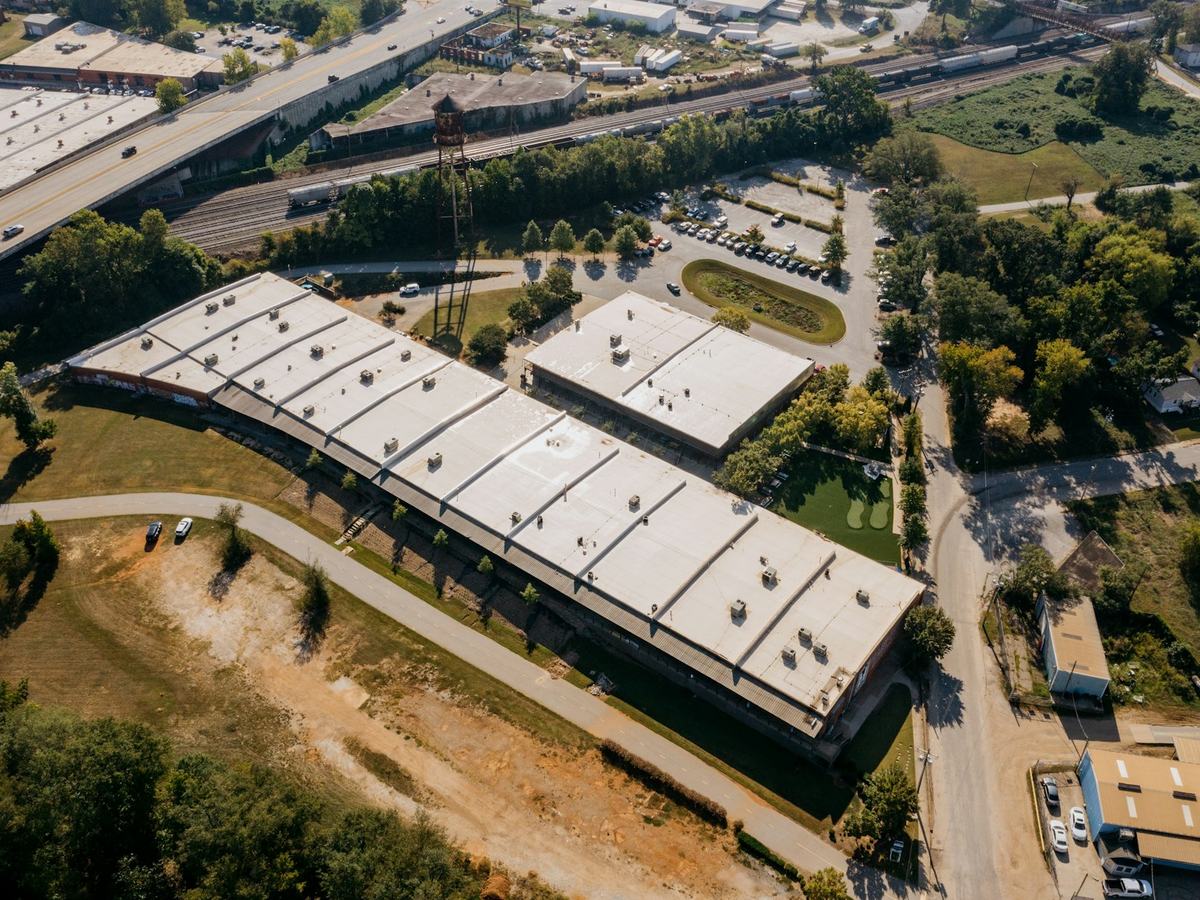
A flat commercial roof hides storm damage better than any pitched roof. There are no shingles to crease, nothing to blow off the ridge, and from the parking lot it looks the same as it did last week. The carrier’s inspector walks it for half an hour, calls the hail marks cosmetic, and the claim closes with a small repair.
The window to change that outcome is before the inspection, not after. What gets documented first — membrane condition, moisture in the insulation, the seams, the drains, the HVAC flashings — sets the terms of the whole claim. Property managers in Joliet, Lombard, Merrillville, and the industrial corridors along I-80 and I-55 deal with this every hail season.
How hail and wind show on each flat roof system
TPO and PVC (single-ply thermoplastic). Hail leaves circular fractures and crazing in the membrane surface that are hard to see standing up and obvious with a flashlight held at a low angle. Older, thinner, or sun-embrittled TPO fractures more easily. Wind shows as lifted or peeled seams, especially at corners and perimeter edges.
EPDM (rubber). Hail punctures and bruises EPDM, particularly over hard substrate or at seams and flashings where the membrane is stretched. Wind pulls up unadhered or ballasted sections and can displace the ballast entirely, leaving bare membrane.
Modified bitumen. Hail fractures the granulated cap sheet and knocks granules off in circular spots, exposing the asphalt underneath. That exposed bitumen then oxidizes and cracks.
Built-up (tar and gravel). Hail displaces gravel, leaving bare patches where the asphalt is exposed. Wind scours gravel off the field of the roof and piles it against parapets.
What gets hit on every roof
Regardless of membrane, storm damage concentrates at the details:
- HVAC curb flashings and unit housings — dented fins, torn flashing, lifted counterflashing.
- Scuppers, drains, and overflow drains — clogged with displaced gravel or debris, cracked bowls, damaged strainers.
- Pipe boots, pitch pockets, and skylights — cracked domes, split boots, hail-fractured lenses.
- Pavers and walkway pads — displaced by wind, cracked by hail, or hiding fractured membrane beneath them.
A carrier inspection that photographs the field of the roof and skips the details is an incomplete inspection.
Why a moisture survey and core samples matter
The membrane is the visible layer. The claim is often decided by what is underneath it. A fractured membrane lets water into the insulation, and wet insulation loses its R-value, gets heavy, and eventually rots the deck. That is functional damage whether or not the roof is dripping into the tenant space yet.
An infrared moisture survey, done at dusk when wet insulation holds heat differently than dry, maps where water has gotten in. Core samples — a small plug cut through the roof assembly and patched — confirm what the infrared shows and identify every layer of the system. Together, they turn “a few hail marks” into a documented picture of the roof’s condition.
Order the survey before the carrier inspects if you can. If the carrier has already been out, order it anyway.
“Cosmetic” versus “functional”
This is the argument on most commercial hail claims. The carrier’s position is that hail marks on the membrane do not affect its ability to shed water, so they are cosmetic and owed nothing, or owed only a small repair. Some policies carry a cosmetic exclusion endorsement that makes this explicit.
The counter is evidence. A fracture that goes through the membrane’s reinforcing scrim is functional. Moisture in the insulation below a hail-marked area is functional. A seam that lifted in wind is functional. The way to make this argument is not to argue it; it is to document the roof well enough that the damage speaks for itself. A public adjuster writes that documentation in the same estimating format the carrier uses. Here is what that process looks like.
Two things to handle alongside the roof claim
What is not our lane
Business interruption, loss of rents, and tenant claims are separate coverages with their own documentation. Trident handles the physical damage claim on the building. For anything related to lost income, call your insurance broker first. We are not attorneys, and a lease question about who bears the repair — landlord or tenant — is one for your counsel or your broker, not for us.
Coordinate with tenants
Tell tenants what happened and what to expect. Ask them to report any interior staining or drips immediately and to photograph it with the date. A tenant who reports a ceiling stain three weeks after the storm has just handed you a piece of evidence that ties the interior damage to the date of loss.
Get a PA and a GC on the roof together
The best commercial storm claims start with two people on the roof at the same time: a public adjuster who knows how the carrier will evaluate it, and a general contractor who knows how the roof will actually be repaired or replaced. The contractor identifies the assembly, the tear-off, the tie-ins, the tapered insulation, the flashing details. The adjuster puts it in the format the carrier reads. Neither one is guessing at the other’s half.
Trident does both. Trident Adjusting & Consulting handles the claim, and Trident Construction Group is a general contractor doing TPO, EPDM, modified bitumen, and metal on commercial buildings. If the carrier’s answer comes back as a denial or a cosmetic-only repair, here is how we approach a denied roof claim, and here is how we handle pushback.
Managing a commercial building that took a hit? Get a public adjuster and a general contractor on the roof before the carrier does. Reach us through the form or call (903) 952-2766.
Quick answers
What does hail damage look like on a TPO roof?
Circular fractures and crazing in the membrane surface, most visible with a flashlight held at a low angle, plus dented HVAC fins, damaged drains, and cracked skylight domes at the details.
Why do carriers call flat roof hail damage “cosmetic”?
The position is that surface marks do not affect the roof’s ability to shed water. Moisture surveys, core samples, and close photos of scrim fractures and seam lifts are how functional damage is shown.
Should I repair my commercial roof before the insurance inspection?
Make emergency patches to stop active leaks, but photograph and measure the damage first and keep all invoices. Do not complete a full repair until both the carrier and your own inspector have seen the roof.